ORIGINAL RESEARCH • ReWeaver AI • 2026
Measuring the
frequency and severity of drift in AI-generated and human-authored code.
AI writes more code.
It doesn't write production-ready code.
The promise was clear: AI coding tools would accelerate development. They have.
What the velocity charts don't show is what is accumulating underneath: bugs, incidents, rework, and drift from the standards the code was supposed to follow. The industry learned to count output. It never learned to count how far that output had drifted from ready.

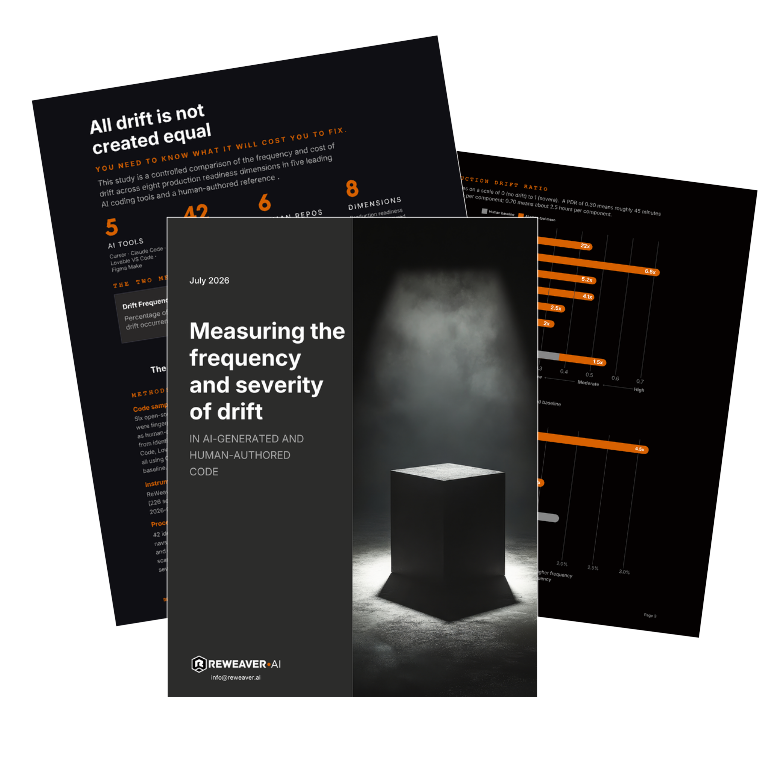
Download the full report.
All drift is not created equal
YOU NEED TO KNOW WHAT IT WILL COST YOU TO FIX.
This study is a controlled comparison of the frequency and cost of drift across eight production readiness dimensions
in five leading AI coding tools and a human-authored reference .
The code sample
We gathered six open-source repositories from a corpus of 21, then fingerprinted and verified them by human review as human-authored. AI-authored code was derived from identical prompts given to Cursor, Claude Code, Lovable, Figma Make, VS Code + Copilot — all using Claude Sonnet 4.6 as the common model baseline.
Instrumentation
ReWeaver, a deterministic drift-scanning engine. (226 scans, 0 failures. Single detector vintage 2026-07-24), was used to detect drift and calculate the Production Drift Ratio
TWO METRICS:
Drift frequency: distinct (file, line) pairs with ≥1 finding ÷ scanned lines.
Production Drift Ratio: Drift frequency weighted by severity × fix-time, normalized per component. PDR 0.30 ≈ 45 min cleanup per scanned file; 0.70 ≈ 2.5 hours per scanned file.
Dimensions Assessed
Design Consistency
User Experience
Security & Privacy
Accessibility
Reliability
Architecture
Testability
Maintainability
Results
We compared frequency and PDR between a human reference and cross-tool means. The comparison sample was too small for statistical significance; however effect size in tests was large and documented clear, directional relationships.
6 of 8
dimensions had no significant differences in drift frequency between human- and AI-authored code.
Both humans and all tools produced drift. No tool won across all dimensions. Instead, tools showed varying profiles of drift.
22×
More costly Security & Privacy drift in AI-authored code.
AI tools produced 3× the human drift frequency but at a cost that was 22× higher. Security drift looks manageable. The PDR reveals it isn't.
3x
More UX drift in AI-authored code.
AI tools produced 5x more costly UX drift than humans, 4x more costly Accessibility drift, and 3x more costly Design Consistency drift.
Takeaways
Raw frequency, considered alone, substantially understates the risk of drift.
In the Security & Privacy dimension, AI tools produced 3x human drift frequency, a gap that looks manageable
until weighted by remediation cost, which was 22x the human reference..
The divergence between frequency and severity reflects a structural property of AI-generated drift.
Models produce drift that looks correct and passes review, while remediation costs are concentrated in findings that require non-trivial structural intervention. Frequency counts what went wrong. The PDR quantifies what it will cost to fix it.
The actionable conclusion is not which tool to use;
it is that any tool requires a verification layer capable
of catching what generation leaves behind.
Download the full report




© 2026 ReWeaver AI, Inc. All rights reserved.